

At our cabin, we watch a long row of quaking aspens. They sit next to the creek that runs through our property. Leaves shimmering. The whole grove moving together like it’s one thing.
It is.
Aspens don’t stand alone. What looks like a hundred trees is usually one organism, connected by a root system that’s been doing invisible work for decades before the first trunk pushes up through the dirt.
That’s what compounding actually looks like.
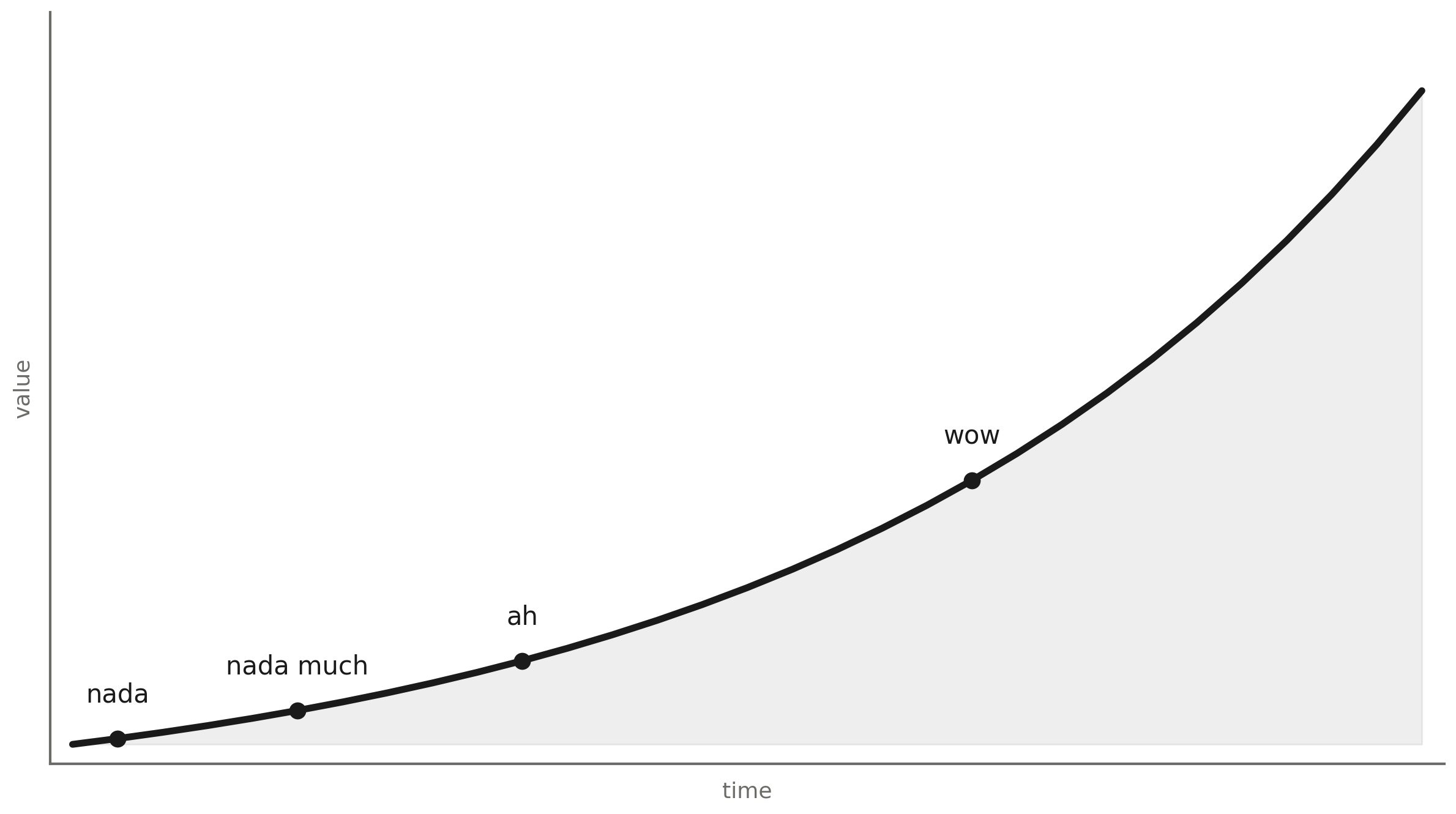
Not the chart you’ve seen a hundred times. Not the math. The root system. Years of nothing visible. Then trees.
Most people understand compound interest intellectually. Very few feel it. Because feeling it requires staying in the game long enough for the curve to bend. And the early part of an exponential curve looks flat. It looks like nothing is happening. It looks like you’re wasting your time.
I put the first hours into IdeaMensch in 2009. For years, it made almost nothing. Traffic was climbing. Revenue was a flat line with a gentle tilt. I’d check it, feel nothing, and close the tab. Same story with the ETFs. Same story with my first commercial property. Nothing was happening above the surface.
Below the surface, a root system was forming.
The interviews were piling up. Every now and then, someone linked to IdeaMensch from somewhere, and the root system grew another inch. By year five, Google started treating the site as a real thing. By year ten, it was the largest interview site on the internet - with real revenues.
I didn’t do anything different in year ten than I did in year two. The work was the same. The root system was just finally big enough to push a tree up.
The ETFs did the same thing. For the first seven years, I’d check the balance and feel mild disappointment. Somewhere around year ten, the number started moving in ways that had nothing to do with how much I was putting in. The account was paying me more than I was paying it. That was the curve bending.
Real estate does it more quietly. You buy a property, it produces a little cash, and the equity creeps up while you’re not looking. Ten years later, without doing anything, you own something worth considerably more than you paid for it, while it’s been paying you monthly the whole time.
Skills compound, too. I’m a better marketer today, not because I read a book. I’ve been doing it for twenty years. Each year builds on the last. That knowledge doesn’t depreciate.
Relationships compound the most, and they’re the hardest to see. The CEO who brought me to Pathlabs used to be a student of mine. That was a decade ago. We’ve been building the relationship ever since, without either of us knowing it would lead here. We just kept showing up for each other.
A few things I’ve learned about staying in the game long enough for the roots to take hold.
Pick something you can keep doing when it’s not working. If it requires willpower every week, it won’t survive year three. IdeaMensch worked because sometimes I might have only had a couple of hours to put into it, and it kept going. That’s sustainable for decades. When a slow bet needs twenty hours a week, it’s not a slow bet.
Automate the money part. I set up the ETF contributions once and never touched them. No decisions. No checking the market. The automation is the whole point.
Don’t check too often. The feedback loop on a slow bet is years, not weeks. Checking weekly just gives you twelve chances a year to quit something that’s working fine.
And keep the downside small enough that a bad year doesn’t force a decision. Most people don’t quit because the bet failed. They quit because they needed the money.
Compounding rewards the people who are still around.
Most people aren’t. They quit in year three because it’s not working. They pull the money in year six because the market’s flat. They leave the job after two years and never build the network that would have mattered in year fifteen. They stop writing after a dozen posts because nobody read them.
I don’t blame them. The early years of a slow bet are brutal. You’re doing the work. You’re putting in the money. You’re showing up. And for a long time, nothing above the surface looks different.
But the roots are forming.
The grove always looks sudden.
It never is.